





Every June 16, the world pauses to celebrate World Sea Turtle Day. It’s a moment to recognize the ancient mariners that have navigated our oceans for more than 100 million years.
Here in Martin County, that celebration feels extra special. For us, sea turtle season is not a distant concept or a nature documentary. It is happening right now, right outside our doors, on the same beaches where visitors come to swim, paddle, and watch the sun rise over the Atlantic.
Martin County is one of the most significant sea turtle nesting destinations in the world. Each year, three species return to our shores to carry on a cycle far older than human civilization. But it doesn’t happen by accident.
Here is what you need to know about the turtles that call our coastline home, and how everyone can play a role in protecting them for generations to come.
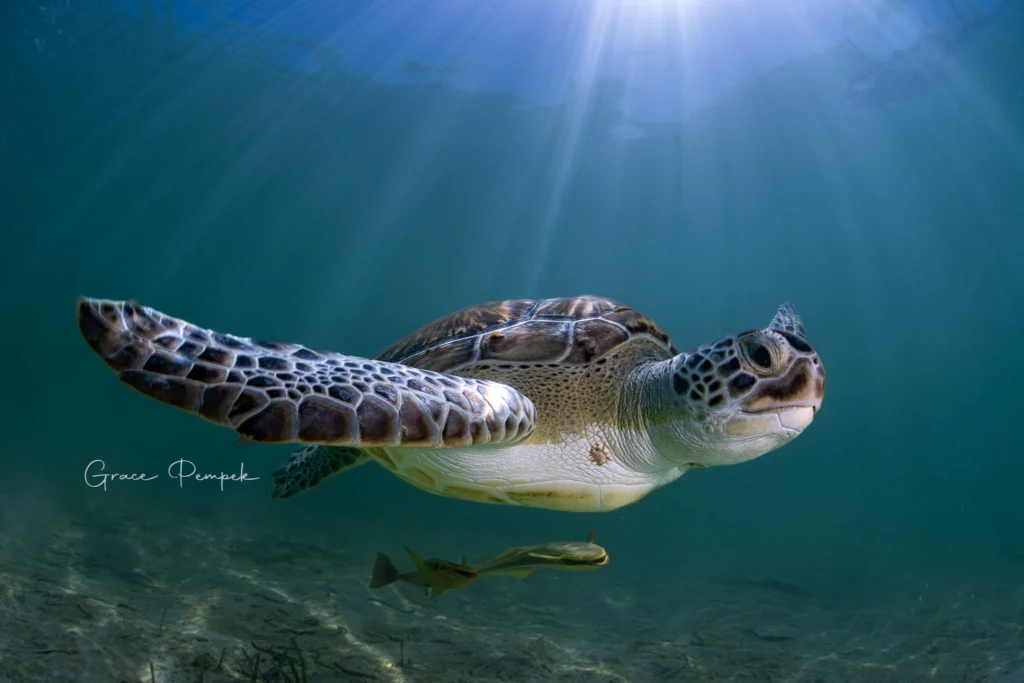
Photo by Grace Pempek – courtesy Hobe Sound Nature Center
Meet the Three Species That Nest on Martin County’s Beaches
- Loggerhead Sea Turtle: The loggerhead is the most common sea turtle to nest in Florida, and Martin County sits squarely within its most critical habitat. According to the Florida Fish and Wildlife Conservation Commission (FWC), Martin County is one of just five counties on Florida’s east coast (alongside Brevard, Indian River, St. Lucie, and Palm Beach) that collectively account for the vast majority of loggerhead nesting in the state. Florida as a whole hosts approximately 90 percent of the nests associated with the Northwest Atlantic loggerhead population, which is considered the largest loggerhead nesting aggregation in the world. They are named for their broad, powerful heads, which help them crush the hard-shelled prey (including crabs, clams, and other invertebrates) that make up their diet. Adults typically weigh between 200 and 350 pounds. Though they are the smallest of the three species that nest here, they are by far the most numerous, with thousands of nests recorded in Martin County each season.
- Green Sea Turtle: Named for the greenish hue of their body fat rather than their shell, green sea turtles are gentle herbivores that graze primarily on seagrass and algae. They are slightly larger than loggerheads, reaching up to 450 pounds. Green turtles tend to nest later in the season and are the second most common species on Martin County beaches. In a recent season, Martin County recorded nearly 10,000 green turtle nests, a meaningful contribution to a species that depends on Florida’s coastline for its survival.
- Leatherback Sea Turtle: The leatherback is the undisputed giant of the sea turtle world. These remarkable animals can grow over six feet long and weigh up to 2,000 pounds. Unlike other sea turtles, leatherbacks have a soft, leathery shell rather than a hard one, allowing them to dive to depths exceeding 3,000 feet in pursuit of their primary prey: jellyfish. Leatherbacks typically nest earlier in the season, and FWC recorded 915 leatherback nests in Martin County last year, an impressive number that reflects just how important our stretch of coastline is to one of the ocean’s most extraordinary species.
The Numbers Tell the Story
Last nesting season alone, the Florida Fish and Wildlife Conservation Commission documented more than 22,500 total sea turtle nests across all three species along Martin County’s 22+ miles of coastline. Those figures place Martin County among the most productive sea turtle nesting areas in the Sunshine State!
Nesting season officially runs from March 1 through October 31, though turtles can occasionally be found nesting outside that window, which is why turtle-safe practices truly make a difference year-round!
How Martin County Is Showing Up for Sea Turtles
Conservation is not just a talking point here. Local organizations, businesses, and community members have taken meaningful, measurable steps to protect nesting sea turtles and their hatchlings.
Florida Oceanographic Society offers coastal education programs a where guests can learn about sea turtle biology and conservation, and even meet their resident sea turtles who can no longer live in the wild! Their team of experts also organizes Nighttime Sea Turtle Walks for small groups.
Hobe Sound Nature Center provides environmental education and seasonal programming focused on native wildlife, including Guided Nighttime Sea Turtle Walks during nesting season that give guests a responsibly managed, up-close look at one of nature’s most moving spectacles.
Explore Natural Martin (our award-winning, in-house ecotourism program developed in partnership with Leave No Trace) organizes free sea turtle programming in partnership with Ecological Associates, Inc. and their special permits. These guided experiences, including nighttime nesting walks and morning beach walks led by trained naturalists, are designed to connect visitors with sea turtle conservation in a meaningful and responsible way. Advance registration is required, and spots fill quickly.
Beyond guided experiences, local partners have also stepped up on the infrastructure side. Many hotels and condominium buildings on Hutchinson Island have made the switch to amber lighting to reduce the disorienting effect that white light has on nesting turtles and emerging hatchlings, a change that directly improves nesting success along one of the county’s most active stretches of beach.
Additionally, many local restaurants participate in the Skip the Straw initiative, opting to provide eco-friendly options instead of plastic straws. This helps reduce single-use plastic pollution in our delicate ecosystems and protects local wildlife, such as sea turtles.
What You Can Do to Help
Whether you’re a visitor or resident, protecting sea turtles doesn’t require a science degree. Just remember three simple words: dark, flat, and clean.
- Dark. Artificial light is one of the greatest threats sea turtles face on the beach. Nesting mothers can be deterred from coming ashore by bright lights, and hatchlings instinctively orient toward the brightest horizon — which should be the ocean, not a beachfront condo. Turn off exterior lights at night, close blinds and curtains in ocean-facing rooms, and leave flashlights and camera flashes in your bag.
- Flat. Holes, sandcastles, and other beach structures can trap or redirect sea turtles trying to nest or reach the water. Before you leave the beach, fill in any holes you have dug and knock down any sand structures. It only takes a couple seconds but makes a real difference.
- Clean. Marine debris is a serious and persistent threat to sea turtles. Remove all trash, beach gear, and equipment before leaving. Items left overnight can entangle or block turtles and hatchlings, and plastic debris can be mistaken for food.
If You Encounter a Sea Turtle or Hatchlings
Seeing a nesting turtle or a wave of hatchlings making their way to the sea is one of the most extraordinary moments any beach visitor can experience. Here is how to make sure your presence helps rather than harms:
- Keep at least 10 feet of distance and stay behind and to the side of a nesting turtle, never between her and the ocean.
- Stay silent and avoid sudden movements and loud noises.
- Never touch, pick up, or attempt to assist hatchlings. It is illegal to touch these creatures, and that first crawl to the ocean imprints essential navigation cues and builds strength critical to their survival.
- Do not use flash photography or shine lights directly at turtles or hatchlings.
If you spot a sea turtle that appears to be injured, disoriented, or in distress, do not attempt to handle it yourself. Leave it to the experts and contact the FWC Wildlife Alert Hotline at 1-888-404-FWCC (3922) and provide the turtle’s location and a description of its condition. You can also opt to submit an online tip through their Wildlife Alert system. Trained responders are equipped to help, and prompt reporting can be lifesaving.
Experience Sea Turtle Season in Martin County
If you are visiting Martin County between March and October, there is a real chance you will encounter evidence of sea turtle activity. Fresh tracks in the morning sand, marked nest sites along the dune line, or, if you are lucky, a nighttime nesting event or hatchling emergence.
To experience sea turtle season with expert guidance, check the Discover Martin calendar for upcoming permitted walks and programs. Spots are limited, advance registration is required, and some require a donation. Needless to say, these experiences consistently rank among the most memorable things visitors take home from a trip to Martin County!
World Sea Turtle Day is a reminder that these animals have survived for over 100 million years. Their continued success depends, in part, on the choices made by the people who share our beaches. In Martin County, we take that responsibility seriously and we invite visitors to be part of that story!